from Age Three and Up
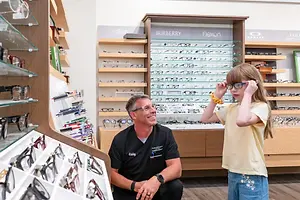
Care for Growing Eyes
Pediatric Eye Exams in Centennial
Children do not always know their vision is off, and many eye problems have no obvious signs. At Hamilton Vision Center, we examine children from age three and up, so we can catch issues early, support learning, and set up a lifetime of healthy vision.
The Importance of Eye Exams for Children
Vision is not just about sight; it is the foundation for how children learn, grow, and experience the world. Up to 80% of what a child learns in school comes through their eyes. When vision is even slightly off, reading becomes a struggle, concentration suffers, and children can fall behind without anyone realizing why.
A comprehensive eye exam goes far beyond a school screening, testing how the eyes work together, how they focus up close and at a distance, and whether the visual system can keep pace with a child's daily demands.
What a Pediatric Eye Exam Covers
Every step is paced to your child's age and attention span. For toddlers, we use non-verbal techniques and equipment so there is no pressure to perform. For school-age children and teens, we take time to explain what we are doing and why, turning the exam into something they can feel good about rather than dread. During the exam, our eye doctors assess:
- Distance and near vision using child-appropriate tools
- Eye teaming and focusing ability, which affect reading stamina and comprehension
- Refractive errors, including nearsightedness, farsightedness, and astigmatism
- Early signs of amblyopia (lazy eye) and strabismus (eye turn)
- Myopia risk evaluation and progression monitoring
- Eye health and structural assessment of the retina, optic nerve, and cornea
Watch for signs that your child may need an exam sooner: squinting, sitting close to screens, frequent headaches, covering or rubbing one eye, losing their place while reading, or trouble paying attention in class. A school vision screening is a helpful flag, but it is not a substitute for a full exam, because screenings miss many focusing and eye-health problems. Visits take about 30 minutes, you are welcome to stay with your child, and we explain whether dilation is needed before we do it.
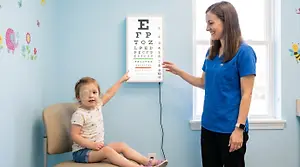
How Often Does Your Child Need an Eye Exam?
The right schedule depends on your child's age, risk factors, and whether they already wear corrective lenses. We offer eye exams for children aged 3 and up. Here is what we recommend at each stage.
Preschool (Ages 3 to 5)
We recommend a full exam before starting school, typically around age 3. This is the ideal window to catch amblyopia (lazy eye) and strabismus (eye turn) while the visual system is still highly responsive to treatment.
Annual exams are advised from this point forward, or more frequently if any concerns are found.
School Age (Ages 6 to 12)
Annual exams are recommended throughout primary school. This is the peak window for myopia onset and progression, and the years when clear vision has the greatest impact on learning.
Children in glasses or contact lenses should be seen every 12 months, or every 6 months if myopia is progressing.
Teenagers (Ages 13 to 18)
Teens should have an eye exam at least every 12 months. Myopia can continue to worsen through the mid-teens, and screen time, study demands, and sports all place high visual loads on teenage eyes.
Teens in contact lenses require annual lens assessments. If your teenager is experiencing headaches, eye strain, or difficulty concentrating, an exam is a good first step.
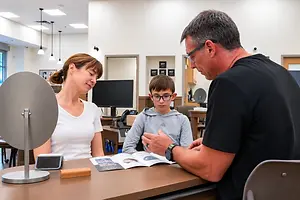
Spotting Myopia Early
Children with high myopia are at substantially increased risk of retinal detachment, glaucoma, and macular degeneration in adulthood. Globally, myopia now affects around 30% of the world's population, and that figure is projected to reach 50% by 2050.
Nearsightedness often starts and accelerates during the primary school years, typically between ages 6 and 14. The earlier we detect it, the more we can do. With myopia management, we can slow the progression rate and significantly reduce the risk of high myopia and its associated complications.
Light Sensitivity and Migraines in Kids
Some children experience migraines and struggle with light sensitivity, and these are not just passing headaches; they can have a significant impact on school performance, concentration, and day-to-day development. Children dealing with frequent migraines may miss school days, avoid reading, and struggle to keep up, often without anyone connecting the dots to a visual trigger.
We offer precision-tinted lens options that filter the specific wavelengths most strongly linked to migraine and photophobia. Learn more about our approach on our Migraine & Light Sensitivity page.

Why Parents Across Centennial Trust Us
Parents bring their children to us because of the depth of care we provide and the range of conditions we are equipped to find and manage.
- Early detection that school screenings miss: We check for amblyopia, strabismus, convergence insufficiency, and color vision deficiencies that a standard vision test will never catch.
- Myopia management: We do not just prescribe glasses and send you home; we actively monitor progression.
- Drug-free migraine and light sensitivity support: Precision-tinted lenses that address the neurological triggers of migraines.
- Age-appropriate exams: Our techniques and tools are chosen for each stage of development, making every visit calm and non-intimidating.
- Bilingual care in English and Spanish, so every family can communicate openly and comfortably.
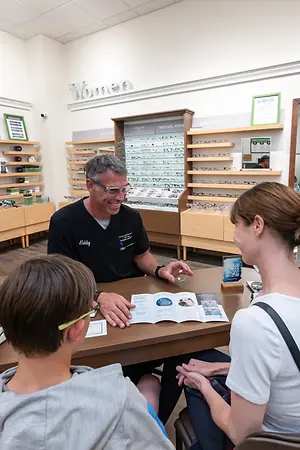
Book Your Child's Eye Exam in Centennial
Give your child a strong start. We care for young patients from Centennial, Greenwood Village, Lone Tree, Cherry Creek, the Denver Tech Center, and Highlands Ranch.
Planning your visit? Start with an eye exam, and see our hours and location for directions and hours.