
With Preventative Medical Care
Protect Your Sight
Eye Disease Management in Centennial
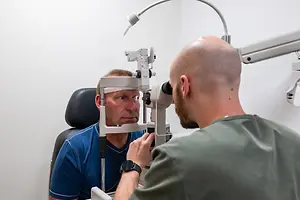
Many eye diseases develop quietly, with no pain and no early change in vision. At Hamilton Vision Center, our eye doctors use advanced imaging to find problems like glaucoma and diabetic eye disease before they threaten your sight, then manage them over the long term.
Eye Diseases Our Centennial Optometrists Manage
Many serious eye conditions, including glaucoma, diabetic retinopathy, and macular degeneration, develop silently, causing permanent damage before you ever notice a change in your vision. At Hamilton Vision Center, we take a medical approach to eye care, using advanced imaging technology to detect signs of disease early, when intervention is most effective. Our goal is not just clear vision today, but protected, functional sight for years to come.
Glaucoma Screenings and Management
Glaucoma is often called the "silent thief of sight" because it affects peripheral vision gradually and painlessly. It is one of the leading causes of irreversible blindness worldwide, yet with early detection and consistent management, the vast majority of patients keep their functional vision.
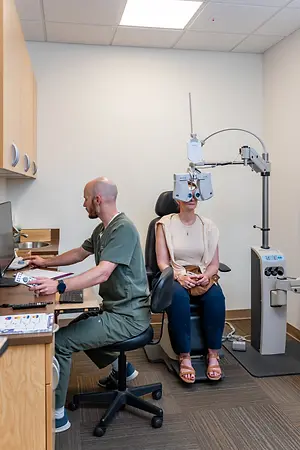
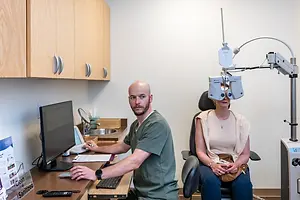
Our diagnostic process goes well beyond a simple pressure check. We measure eye pressure, evaluate the optic nerve with high-resolution imaging, and assess the thickness of the retinal nerve fiber layer using OCT.
For patients already diagnosed, we provide ongoing monitoring to catch any progression and adjust treatment as needed. When drops or medications are prescribed, we make sure you understand how to use them and what to watch for. If your condition advances to where surgery is appropriate, we coordinate referrals with experienced local glaucoma surgeons and continue your follow-up care here.
Diabetic Eye Care and OCT Angiography
Diabetes is one of the most significant systemic threats to eye health. Diabetic retinopathy, damage to the small blood vessels that supply the retina, is the leading cause of new blindness among working-age adults in the United States.
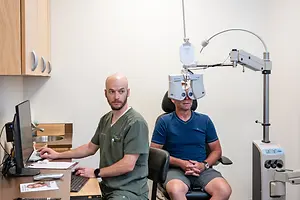
We use OCT angiography (OCTA), an advanced imaging technology that maps the retinal vasculature to detect subclinical microvascular changes that would not be visible on a standard dilated eye exam. This allows us to identify early diabetic retinopathy and macular edema before they threaten your central vision.
Diabetic eye exams are recommended at least once a year for anyone with Type 1 or Type 2 diabetes and more frequently if changes have already been detected.
Age-Related Macular Degeneration (AMD)
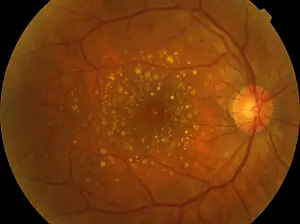
AMD is the leading cause of central vision loss in adults over 60. Because early AMD causes no pain and may not noticeably blur your vision at first, it is easy to miss without targeted testing.
We use OCT imaging to detect drusen deposits and retinal layer changes at the earliest possible stage. If you are diagnosed with AMD, we monitor your progression and, for appropriate patients, offer guidance on lifestyle changes and nutritional supplements that may help slow it, coordinating with a retinal specialist when needed.
Cataract Monitoring & Co-Management
Cataracts develop gradually as the natural lens inside your eye becomes cloudy, dimming and blurring your vision over time. Many patients live with early cataracts for years without knowing it. During your medical eye exam, we assess the density and location of any lens clouding and help you understand how it affects your functional vision.
When it is time for surgery, we refer you to a trusted cataract surgeon and provide comprehensive pre- and post-operative care so you can return to sharp, comfortable vision as quickly as possible.
Keratoconus and Other Eye Conditions
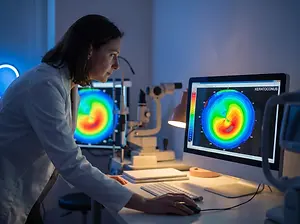
Keratoconus is a progressive condition in which the cornea gradually thins and bulges into a cone-like shape, distorting vision in ways glasses often cannot fully correct. Management ranges from specialty contact lenses to cross-linking referrals that can slow or halt progression before significant vision loss.
We also see patients during office hours for urgent concerns, including red eyes, conjunctivitis, corneal infections, and foreign body removal. Call us right away if you notice a sudden burst of floaters, flashes of light, a curtain or shadow over your vision, eye pain, or new distortion, since these can signal a problem that needs prompt care. If you wake up with an uncomfortable or inflamed eye, call Hamilton Vision Center; most eye problems are best handled by an eye doctor with the right equipment and training.
Book a Medical Eye Exam in Centennial
If you have diabetes, a family history of glaucoma, or notice changes in your vision, do not wait. We care for patients across the South Denver metro.
Planning your visit? Start with an eye exam, and see our hours and location for directions and hours.